₱0.00

When life gets busy, people naturally look for the shortest explanation they can find. They want quick answers, quick tips, and quick summaries.
I’ve done the same.
When ChatGPT and other AI tools became part of my daily life, I found myself reading more summaries than full articles or books. It saved time, and sometimes that was exactly what I needed.
There is nothing wrong with short content. It gives me a quick understanding of an idea, but I realized that it should never replace the depth, context, and understanding that long-form content provides.
What Short Content Can Miss
Over time, I found myself becoming unsatisfied with the short versions. I kept thinking that I needed to know the context of the original source.
I couldn’t brush off the feeling that an excerpt from an article, a book, or an online source is only one small part of a much bigger work. Before I form an opinion based on a piece of information, I need to understand the bigger picture first.
A short explanation can give me the main idea, but it cannot always give me the full picture. It may leave out the background, the small details, or the different sides of an issue.
What if, by the end of the article or book, the author actually reaches a different conclusion?
When I only read the shortest version, I miss the context behind the information. I think this is one reason why so many arguments happen online. People often know only a small part of the story, and the result is endless chaos, especially in comment sections.
People defend unverified claims, spread false information, or argue over posts that have been taken out of context.
Why I’m Choosing Depth
Because of that, I’m choosing the longer road.
In a time when so much content is made to be consumed in seconds, and when people often form conclusions from those few seconds, I want to slow down.
I want to read books, long articles, and trusted sources whenever I can. Sometimes, I even go to the public library just to spend time reading books related to a topic I want to understand better.
“But doesn’t that slow you down?”
Yes, it does.
But why the rush, anyway?
I’ve noticed that when I have conversations with people, I can honestly and confidently say, “I only know a little about this topic.”
Then I ask questions and let them share what they know.
I don’t have to win. I don’t have to argue. Instead, it becomes a healthy conversation between two people who are learning from each other.
To me, that’s another kind of long-form content. It is not written on pages, but it is shared through conversations.
What Long-Form Content Builds
Reading deeply does more than give me information.
It teaches me to think before I agree or disagree. It helps me become a critical thinker.
I’ve read a quote before saying that citizens who read are harder to be manipulated by government propaganda. I don’t think reading alone can make a country less corrupt because corruption is influenced by many factors.
However, I believe deep and critical reading can help people ask better questions.
Is this headline true?
Where did this information come from?
What is the context behind this statement?
Those questions can make a difference if more people practice them.
I sometimes miss the days when news networks introduced us to stories we did not already know. It can be frustrating because even media outlets sometimes create content based on what is already trending online.
There was even a time when some platforms shared information that later turned out to be false.
Of course, sharing trending stories is not always bad. Trends can reveal important conversations. But I also miss seeing more deeply researched stories—stories where journalists interviewed people, investigated issues, and looked for events that were truly worth reporting.
I am glad that some media organizations are slowly bringing back more long-form content, and I hope this continues.
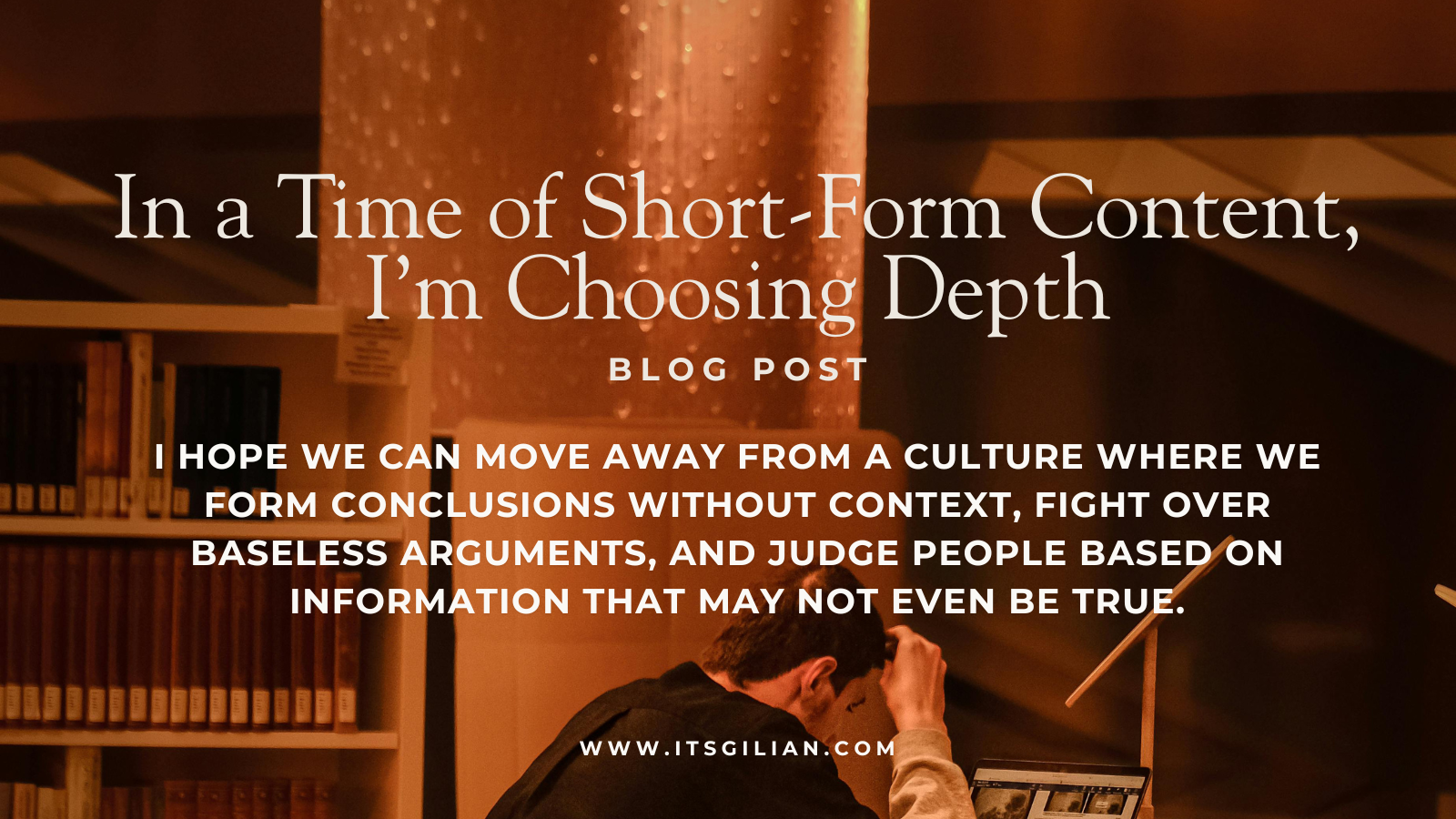
I hope we can move away from a culture where we form conclusions without context, fight over baseless arguments, and judge people based on information that may not even be true.
A Final Thought
I will still read short-form content and summaries, of course. They are helpful for getting an overview or finding a starting point.
But I don’t want to stop there.
I want to spend more time with long-form content: thoughtful articles, academic journals, non-fiction books (not something a story-loving woman like me usually chooses, but let’s try), longer videos, documentaries, and conversations that challenge my thinking.
I think you get the point.
In a modern world that chooses to stop at short-form content, I want to carry on by adding long-form content that could help me understand the topic deeper, know the context, and improve my critical thinking skills.